
Affiliate Disclosure: This article contains affiliate links. If you purchase through a qualifying link, we may earn a commission at no additional cost to you. This PowMr 60A MPPT Review is based on published product specifications, available product information, visible customer feedback, comparison research, and practical buying considerations. We have not personally conducted hands-on testing of the PowMr HHJ-60A.
Quick Verdict: PowMr 60A MPPT Review
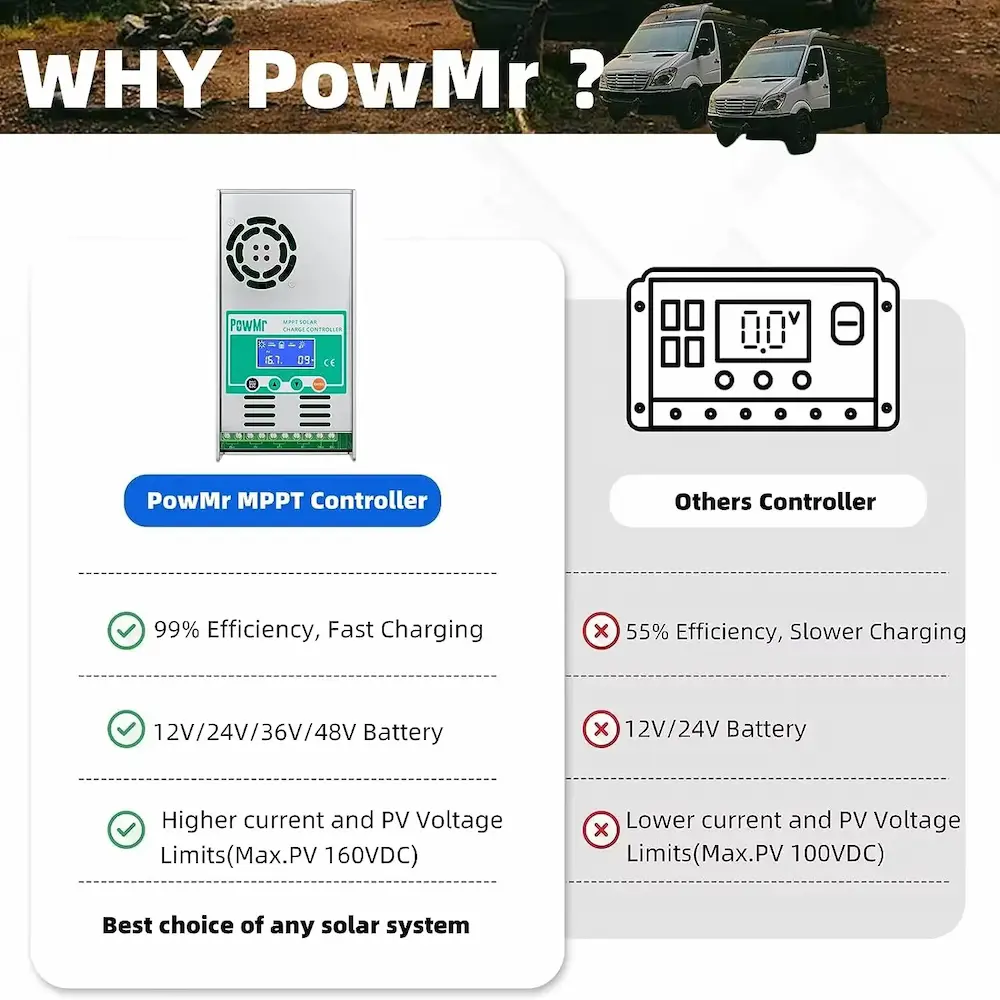
The PowMr 60A MPPT Review covers the HHJ-60A, a solar charge controller designed for 12V, 24V, 36V and 48V battery systems. The controller uses MPPT charging, supports up to 60A rated charging current and accepts different PV voltage ranges depending on the battery-system voltage.
The listing also advertises a maximum PV input voltage of 160V, while the technical documentation gives system-specific PV input ranges from 20–80V for 12V systems through 72–160V for 48V systems. It also lists maximum PV input power of 720W, 1,440W, 2,100W and 2,800W for 12V, 24V, 36V and 48V systems respectively.
The HHJ-60A is therefore more suitable for planned off-grid, RV, backup or solar-storage systems than for someone looking for a simple plug-and-play controller.
Our Research-Based Rating: 4.4/5
This rating reflects the published specifications, available customer feedback and practical system considerations. It does not represent hands-on testing.
PowMr 60A MPPT Review: Specifications
| Feature | Details |
|---|---|
| Brand | PowMr |
| Model | HHJ-60A |
| Controller Type | MPPT Solar Charge Controller |
| Rated Charging Current | 60A |
| Battery Systems | 12V / 24V / 36V / 48V |
| Charging | 3-stage MPPT |
| 12V PV Input Range | 20–80V |
| 24V PV Input Range | 37–105V |
| 36V PV Input Range | 50–160V |
| 48V PV Input Range | 72–160V |
| Max PV Power at 12V | 720W |
| Max PV Power at 24V | 1,440W |
| Max PV Power at 36V | 2,100W |
| Max PV Power at 48V | 2,800W |
| Max Efficiency | ≥98.1% |
| PV Utilization | ≥99% |
| Limited Current Protection | 61A |
| Overcharge Protection | 60V |
| Temperature Protection | 75°C / 167°F |
| Fan Start | Above 45°C / 104°F |
| Fan Stop | Below 40°C / 95°F |
| Enclosure | IP21 |
| Dimensions | Approx. 214 × 115 × 50mm |
| Net Weight | Approx. 1.1kg |
| Operating Temperature | -20°C to +55°C |
These specifications come from PowMr’s HHJ-60A documentation and supporting manuals.
What Is the PowMr 60A MPPT Controller?
The PowMr HHJ-60A is a solar charge controller that sits between solar panels and a battery bank.
Its job is to regulate the electrical energy coming from the solar array so the battery receives an appropriate charging current and voltage.
Unlike a basic PWM controller, the HHJ-60A uses Maximum Power Point Tracking, or MPPT. This technology allows the controller to adjust the electrical operating point of the solar array to make better use of available PV power under changing conditions.
The U.S. Department of Energy explains that solar systems use charge controllers to regulate battery charging and help protect batteries from overcharging or excessive discharge.
60A Charging Capacity
The headline specification is the controller’s 60A rated charging current.
That makes the HHJ-60A more appropriate for medium-to-large 12V, 24V, 36V or 48V solar systems than a small controller designed for a single modest panel.
However, 60A does not mean that every connected solar array should provide 60A at all times.
Actual charging current depends on:
- Solar-panel output
- Battery voltage
- Sunlight conditions
- Panel configuration
- Battery state of charge
- Controller limits
- System voltage
The controller documentation also specifies different maximum PV power limits for each battery-system voltage. At 48V, for example, the listed maximum PV input power is 2,800W.
12V, 24V, 36V and 48V Compatibility
One of the useful features of the HHJ-60A is its support for four common system voltages.
It can automatically recognize:
- 12V systems
- 24V systems
- 36V systems
- 48V systems
The controller’s PV voltage window changes with the battery-system voltage. A 12V system has a 20–80V PV input range, while a 48V system supports 72–160V according to the HHJ-60A documentation.
That flexibility can make the controller useful for different solar installations.
However, automatic battery-voltage recognition does not mean you can connect any solar panel combination without checking the electrical specifications first.
160V PV Input Capability
The listing prominently advertises 160V maximum PV input, but this figure needs context.
The HHJ-60A documentation gives the following PV ranges:
- 12V system: 20–80V
- 24V system: 37–105V
- 36V system: 50–160V
- 48V system: 72–160V
Therefore, 160V is not the operating range for every battery configuration. It applies to the higher-voltage system configurations.
This distinction is important when designing a solar array.
Panel open-circuit voltage can also rise in colder conditions, so system designers should calculate the maximum expected PV voltage rather than simply matching the nominal panel voltage to the controller’s advertised maximum.
Maximum PV Power by System Voltage
The HHJ-60A also uses different maximum PV power limits depending on the battery-system voltage.
| Battery System | Maximum Listed PV Power |
|---|---|
| 12V | 720W |
| 24V | 1,440W |
| 36V | 2,100W |
| 48V | 2,800W |
This structure makes sense because higher-voltage battery systems can handle the same charging power with lower current on the battery side.
For example, a 2,800W solar array paired with a 48V battery system represents a very different current requirement from a 2,800W array on a 12V system.
The controller therefore needs to be matched to the complete system rather than judged only by its 60A headline rating.
MPPT Charging and Efficiency
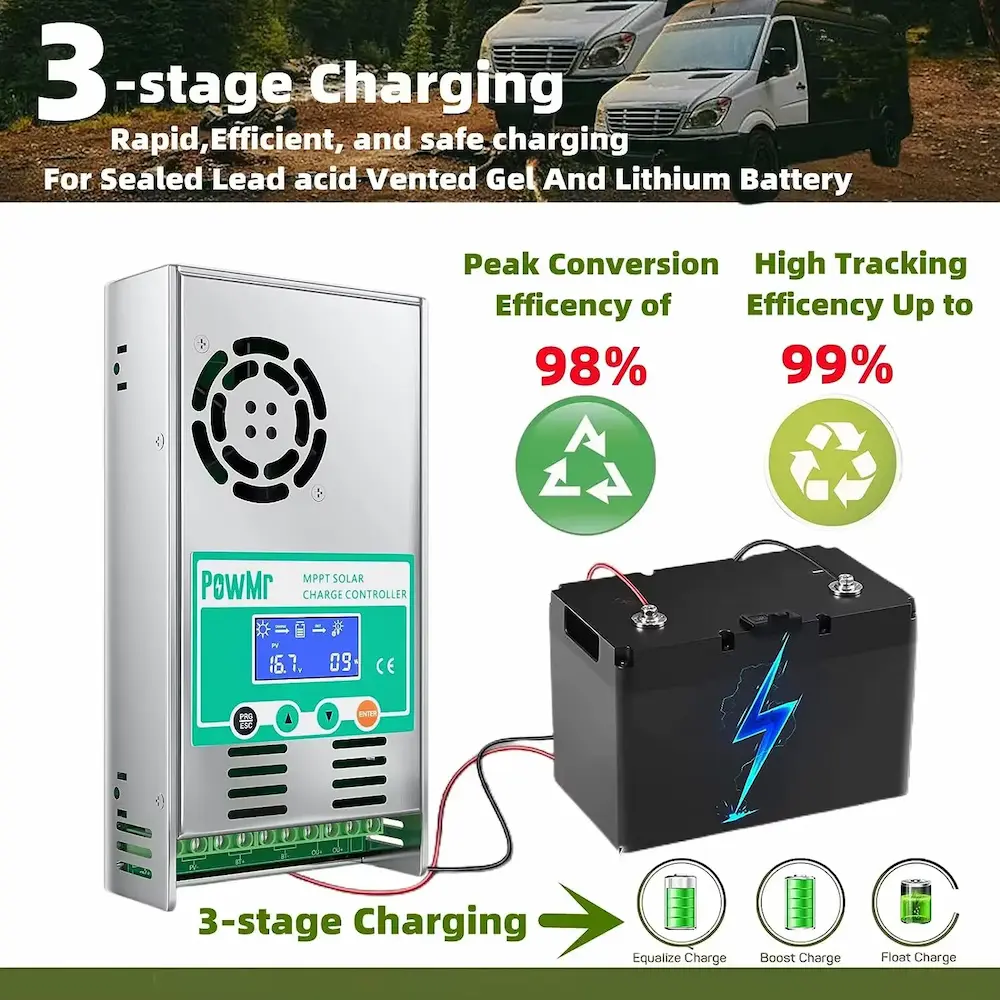
The manufacturer documentation lists maximum efficiency of at least 98.1% and PV utilization of at least 99% for the HHJ-60A.
These are manufacturer specifications rather than independent laboratory measurements.
MPPT technology can be especially useful when the solar-panel voltage differs substantially from the battery voltage. The controller continuously adjusts its operating point to extract available power from the PV array and convert it for battery charging.
Real-world efficiency will vary with temperature, load, PV voltage, wiring and operating conditions.
Three-Stage Charging
The HHJ-60A uses a three-stage charging approach.
The documentation describes the charging process around:
- Constant-current / MPPT charging
- Constant-voltage charging
- Floating
This type of staged charging is common in battery charging systems because the battery’s charging requirements change as its state of charge increases.
The exact charging parameters should be matched to the battery chemistry and manufacturer’s recommended settings.
That point matters especially if you plan to use lithium batteries rather than traditional lead-acid batteries.
Battery Compatibility
The PowMr HHJ-60A is designed for different battery types depending on the configuration and charging settings.
The broader PowMr controller documentation identifies support for battery categories including lead-acid and lithium batteries, while the specific HHJ-60A documentation provides the charging and voltage ranges.
Before installation, check whether the battery manufacturer provides the correct charging voltage and profile for use with the controller.
A solar controller should not be selected solely on its current rating. Battery chemistry and charging requirements are equally important.
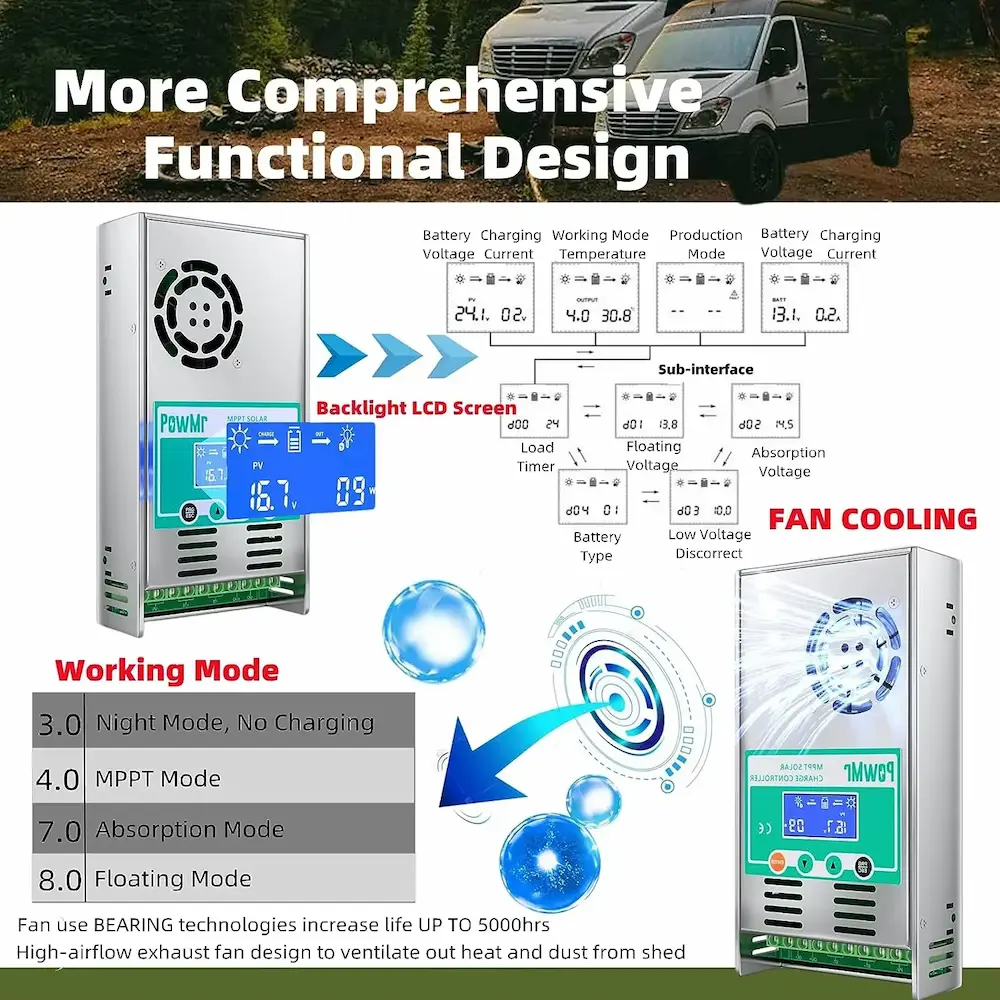
Cooling and Temperature Protection
The HHJ-60A uses forced-air cooling with an internal fan.
The published specifications state that the fan starts above approximately 45°C and stops below approximately 40°C. Temperature protection is listed at 75°C.
Active cooling can help manage heat when the controller handles significant solar input.
The trade-off is that a fan introduces a moving component and some audible noise. Installation location therefore matters.
A controller installed in a poorly ventilated enclosure may run hotter than one mounted in an open, well-ventilated location.
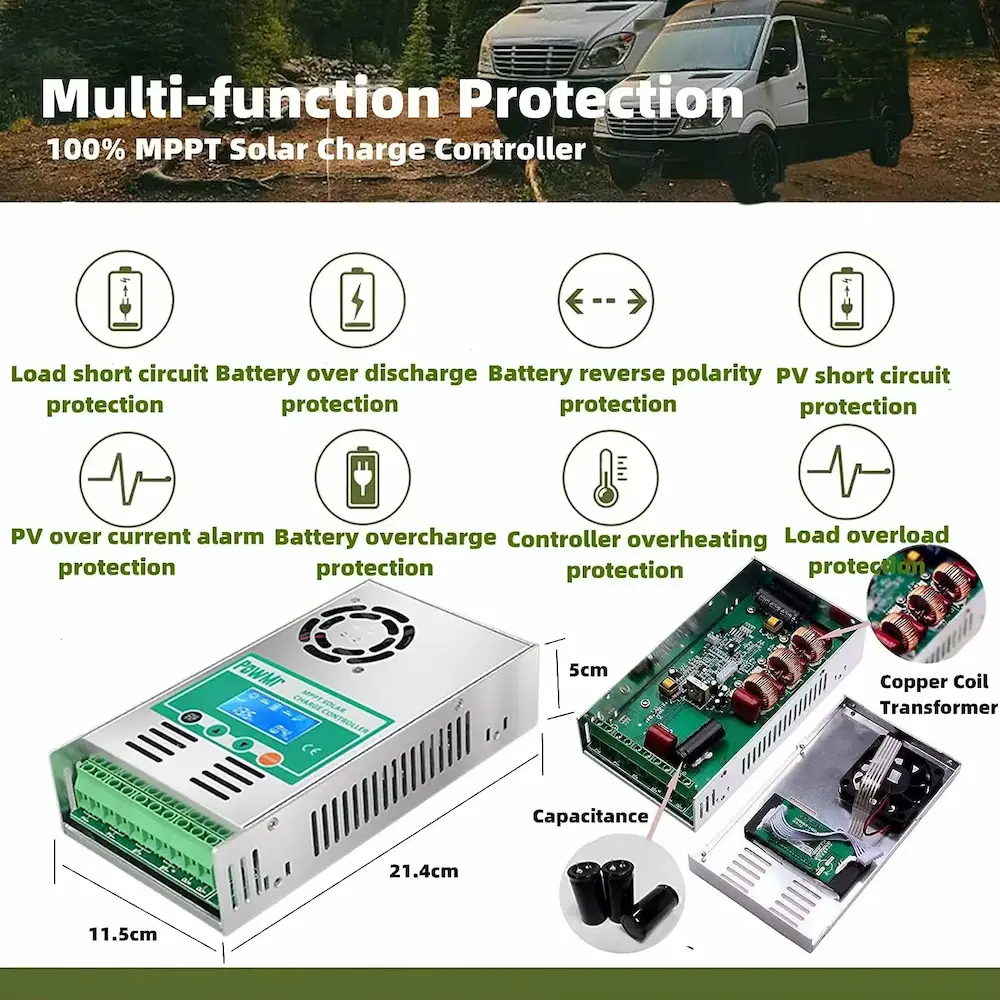
Built-In Protection Features
The HHJ-60A documentation lists several protection functions.
These include:
- Overcharge protection
- Battery over-discharge protection
- Load overcurrent protection
- Load short-circuit protection
- Temperature protection
- PV-related protection
The limited current protection is listed at 61A, just above the controller’s 60A rated charging current.
These protections can reduce the risk of damage from certain electrical faults, but they do not replace external fuses, disconnects, correct cable sizing or proper installation practices.
LCD Display and Configuration
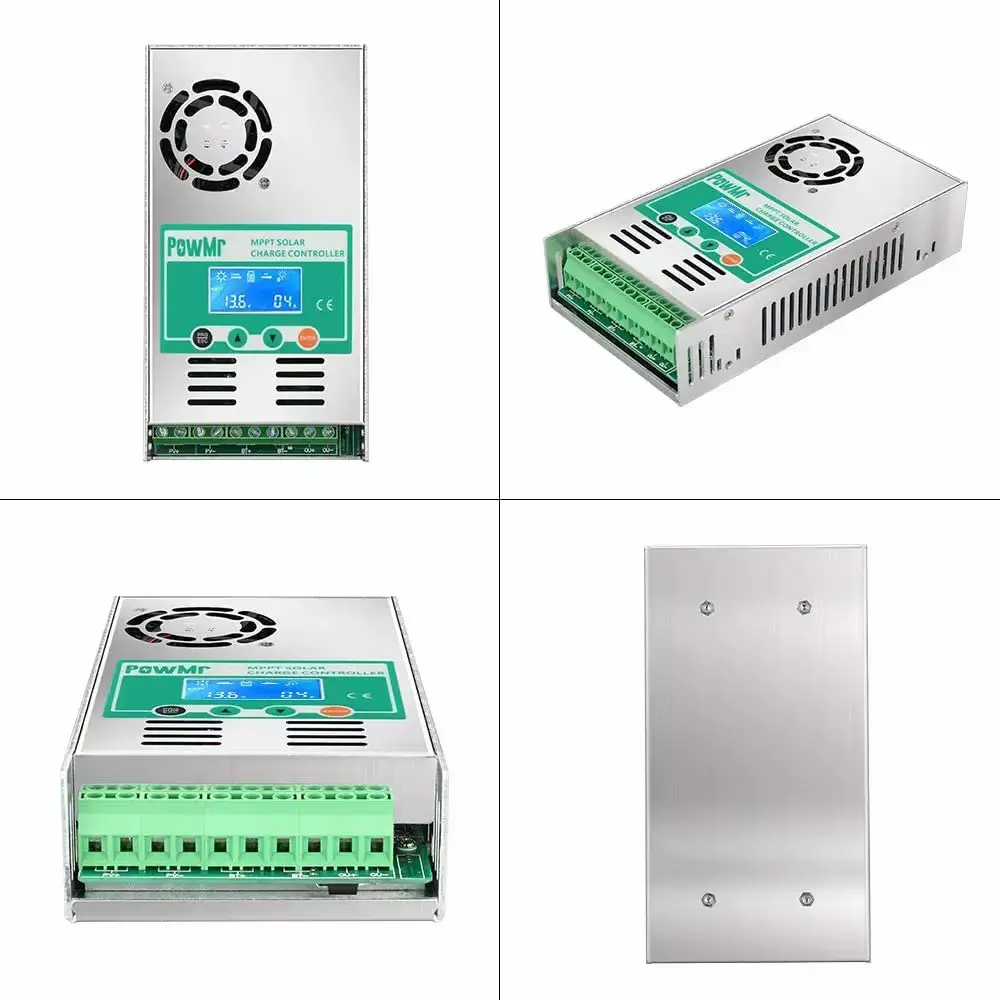
The physical controller shown in the product listing has a front LCD-style display and buttons.
This interface allows users to view and configure important system information rather than relying entirely on an external monitoring device.
That can be useful during installation because the user can check battery voltage and charging information directly at the controller.
The display is functional rather than a modern smart-home interface. Buyers looking for Wi-Fi or app-based monitoring should confirm whether the specific HHJ-60A configuration offers that functionality before ordering.
PowMr 60A MPPT for RV Solar Systems
The HHJ-60A can make sense in an RV solar system when the panel array and battery bank fall within its electrical limits.
Potential uses include:
- RV battery charging
- Campervan solar
- Off-grid lighting
- Refrigerator power systems
- Small appliance systems
- Mobile workstations
- Backup battery charging
Its 12V–48V compatibility gives system designers more flexibility than a controller restricted to one battery voltage.
The physical size is also relatively compact at approximately 214 × 115 × 50mm, although the surrounding wiring and ventilation requirements still need adequate installation space.
PowMr 60A MPPT for Off-Grid Solar
Off-grid systems can benefit from a controller that supports higher PV input and multiple battery voltages.
The HHJ-60A’s 2,800W maximum listed PV input at 48V makes it suitable on paper for substantially larger solar arrays than small 10A or 20A controllers.
However, the complete system still needs:
- Properly sized solar panels
- Suitable battery capacity
- Correct PV wiring
- Appropriate DC protection
- Correct battery cables
- Proper grounding
- A compatible inverter if AC loads are required
The controller is only one component of the complete solar system.
PowMr 60A MPPT and ECO-WORTHY 280Ah Battery
A large MPPT controller can pair naturally with a high-capacity lithium battery when the charging specifications match.
If you are planning a larger off-grid or RV power system, you can also compare the ECO-WORTHY 280Ah Battery Review 2026: Is It Worth Buying?.
That battery provides a 12V-class, 280Ah LiFePO4 storage option, while the PowMr controller handles the solar-to-battery charging side of the system.
The important point is compatibility. The battery’s recommended charging voltage and current must match the controller’s configuration.
PowMr 60A MPPT and Multi-Cooker Power Systems
Solar power systems are often used to supply household and portable appliances through an inverter.
For example, the 220V Multi-Cooker Electric Pot Review 2026: Is It Worth Buying? covers a very different type of product, but it can be relevant when thinking about what an off-grid battery-and-inverter system may need to power.
A high-wattage appliance can place a substantial load on a battery system, so users should calculate inverter capacity, battery current and available stored energy before connecting appliances.
The controller itself does not power an AC appliance directly. Its job is to manage energy flowing from the solar panels into the battery system.
Customer Feedback
The supplied AliExpress listing showed the HHJ-60A with a 5.0/5 rating from 8 reviews and approximately 60 sold at the time captured in the product video.
The visible reviews included multiple five-star ratings. One additional review simply stated that “everything is fine.”
Because the listing contained relatively few written comments, the customer-feedback section provides less information than a product with hundreds of detailed reviews.
The positive rating is useful as an indication of buyer satisfaction on that listing, but it should not be treated as independent performance testing.
Build and Installation Considerations
The HHJ-60A uses a metal-looking rectangular enclosure with ventilation openings and an integrated cooling fan.
Its approximately 1.1kg net weight makes it relatively manageable to mount compared with larger solar power electronics.
Still, installation requires care because the controller handles potentially high DC voltage.
The installation location should provide:
- Adequate ventilation
- Protection from direct water exposure
- Enough space around ventilation openings
- Secure mounting
- Short and correctly sized battery cables where practical
- Suitable PV and battery disconnects
The published enclosure rating is IP21, so this is not a weatherproof outdoor controller that should be mounted uncovered in rain.
Safety and Solar System Planning
A solar charge controller sits inside a system containing potentially hazardous DC voltage and high current.
The U.S. Department of Energy explains that a complete solar electric system includes multiple components, including PV modules, batteries, charge controllers, wiring and disconnect equipment.
For that reason, the controller should be installed as part of a properly designed system rather than treated as a standalone electronic gadget.
Check the PV array’s maximum open-circuit voltage, the battery voltage, expected charging current and the required protective devices before connecting anything.
PowMr 60A MPPT Review: Pros and Cons
Pros
- 60A rated MPPT charging
- Supports 12V, 24V, 36V and 48V systems
- Up to 160V PV input range on supported higher-voltage configurations
- Up to 2,800W listed PV input at 48V
- 3-stage charging
- Automatic battery-voltage recognition
- Published maximum efficiency of ≥98.1%
- Multiple protection functions
- Built-in cooling fan
- LCD and physical controls
- Compact approximately 1.1kg design
- Suitable for RV and off-grid applications
Cons
- Exact PV voltage range depends on battery-system voltage
- 160V is not the operating range for every system
- No independent performance testing in this review
- IP21 enclosure is not suitable for exposed outdoor mounting
- Fan cooling introduces noise and a moving component
- Installation requires correct DC protection and cable sizing
- Customer review count on the supplied listing is relatively small
- Buyers should verify the exact HHJ-60A version before ordering
Who Should Consider the PowMr HHJ-60A?
The HHJ-60A may be worth considering for users building:
- RV solar systems
- Campervan power systems
- Off-grid battery banks
- Backup solar systems
- Small residential solar-storage systems
- 12V solar installations
- 24V solar installations
- 36V solar installations
- 48V solar installations
It is especially interesting for users who need more than a small solar controller and want a single unit that supports several common battery-system voltages.
Who Should Skip It?
The controller may be excessive for a small solar setup with only a modest panel and battery.
It may also be unsuitable for users who want a completely weatherproof controller for exposed outdoor installation because its published enclosure rating is IP21.
Likewise, anyone looking for advanced Wi-Fi or app-based monitoring should confirm the exact model before purchase rather than assuming that every PowMr controller includes the same smart features.
PowMr 60A MPPT Review: Buying Guide
Before ordering the PowMr HHJ-60A, check these points:
1. Confirm the model
Make sure the listing says HHJ-60A rather than another PowMr 60A controller.
2. Calculate PV voltage
Check the solar panels’ open-circuit voltage and make sure the complete string remains inside the controller’s allowed range.
3. Check PV wattage
The maximum listed PV power changes with system voltage, from 720W at 12V to 2,800W at 48V.
4. Confirm battery voltage
The controller supports 12V, 24V, 36V and 48V systems, but the PV input requirements change for each.
5. Check battery chemistry
Confirm the correct charging profile for your battery before installation.
6. Plan the cables
A 60A controller can require substantial battery-side conductors. Follow the manufacturer’s installation guidance and local electrical requirements.
7. Add suitable protection
Use appropriately rated fuses, breakers or disconnects where required by the system design.
8. Plan ventilation
The controller uses fan-assisted cooling, so avoid sealing it inside a small unventilated compartment.
9. Check the enclosure rating
IP21 does not mean waterproof. Protect the controller from direct rain and water exposure.
10. Verify the selected listing
PowMr sells several 60A controllers with different features. Compare the exact model number and manual before purchasing.
Review Methodology: What We Considered
For this PowMr 60A MPPT Review, we considered the supplied AliExpress product listing and video, the visible customer feedback, PowMr’s published product information and HHJ-60A technical documentation.
We also checked the published specifications for PV input ranges, maximum PV power, battery-system compatibility, charging current, efficiency, temperature protection, enclosure rating and physical dimensions.
We did not treat marketplace marketing claims as independently verified laboratory measurements. Since no hands-on testing was conducted, this review does not claim personal experience with the controller’s charging efficiency, thermal performance, noise level or long-term reliability.
PowMr 60A MPPT Review: Final Verdict
The PowMr HHJ-60A offers a useful combination of 60A MPPT charging, 12V/24V/36V/48V compatibility and relatively high PV input limits. Its published specifications make it relevant to medium-to-large off-grid, RV and battery-storage projects.
The most important point is that the 160V PV figure needs context. The controller’s allowed PV voltage changes according to the battery-system voltage, and its maximum PV wattage also changes from 720W at 12V to 2,800W at 48V.
Its compact size, LCD interface, automatic voltage recognition, protection features and forced-air cooling add practical value. At the same time, the IP21 enclosure means it needs a protected installation environment, and the 60A rating requires careful attention to wiring and system protection.
For users who need a flexible 60A MPPT controller and can correctly match the solar array and battery bank to its specifications, the HHJ-60A presents a capable feature set on paper.
👉 Check the current PowMr HHJ-60A listing, exact specifications, PV voltage limits and selected configuration before purchase.