PowMr 60A MPPT Review 2026: Is It Worth Buying?
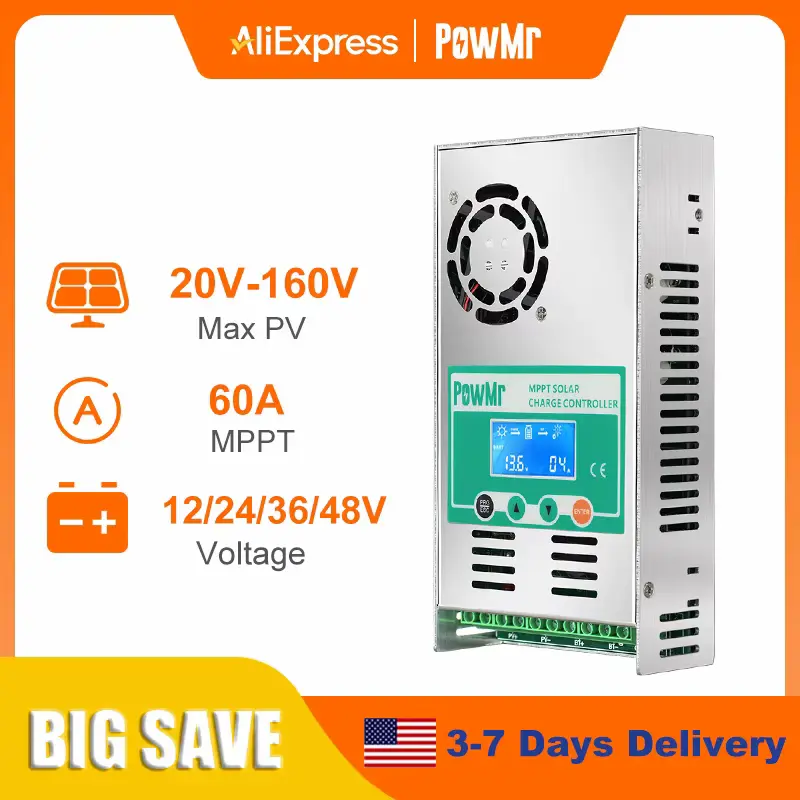
Affiliate Disclosure: This article contains affiliate links. If you purchase through a qualifying link, we may earn a commission at no additional cost to you. This PowMr 60A MPPT Review is based on published product specifications, available product information, visible customer feedback, comparison research, and practical buying considerations. We have not personally conducted hands-on testing of the PowMr HHJ-60A. Quick Verdict: PowMr 60A MPPT Review The PowMr 60A MPPT Review covers the HHJ-60A, a solar charge controller designed for 12V, 24V, 36V and 48V battery systems. The controller uses MPPT charging, supports up to 60A rated charging current and accepts different PV voltage ranges depending on the battery-system voltage. The listing also advertises a maximum PV input voltage of 160V, while the technical documentation gives system-specific PV input ranges from 20–80V for 12V systems through 72–160V for 48V systems. It also lists maximum PV input power of 720W, 1,440W, 2,100W and 2,800W for 12V, 24V, 36V and 48V systems respectively. The HHJ-60A is therefore more suitable for planned off-grid, RV, backup or solar-storage systems than for someone looking for a simple plug-and-play controller. Our Research-Based Rating: 4.4/5 This rating reflects the published specifications, available customer feedback and practical system considerations. It does not represent hands-on testing. PowMr 60A MPPT Review: Specifications Feature Details Brand PowMr Model HHJ-60A Controller Type MPPT Solar Charge Controller Rated Charging Current 60A Battery Systems 12V / 24V / 36V / 48V Charging 3-stage MPPT 12V PV Input Range 20–80V 24V PV Input Range 37–105V 36V PV Input Range 50–160V 48V PV Input Range 72–160V Max PV Power at 12V 720W Max PV Power at 24V 1,440W Max PV Power at 36V 2,100W Max PV Power at 48V 2,800W Max Efficiency ≥98.1% PV Utilization ≥99% Limited Current Protection 61A Overcharge Protection 60V Temperature Protection 75°C / 167°F Fan Start Above 45°C / 104°F Fan Stop Below 40°C / 95°F Enclosure IP21 Dimensions Approx. 214 × 115 × 50mm Net Weight Approx. 1.1kg Operating Temperature -20°C to +55°C These specifications come from PowMr’s HHJ-60A documentation and supporting manuals. What Is the PowMr 60A MPPT Controller? The PowMr HHJ-60A is a solar charge controller that sits between solar panels and a battery bank. Its job is to regulate the electrical energy coming from the solar array so the battery receives an appropriate charging current and voltage. Unlike a basic PWM controller, the HHJ-60A uses Maximum Power Point Tracking, or MPPT. This technology allows the controller to adjust the electrical operating point of the solar array to make better use of available PV power under changing conditions. The U.S. Department of Energy explains that solar systems use charge controllers to regulate battery charging and help protect batteries from overcharging or excessive discharge. 60A Charging Capacity The headline specification is the controller’s 60A rated charging current. That makes the HHJ-60A more appropriate for medium-to-large 12V, 24V, 36V or 48V solar systems than a small controller designed for a single modest panel. However, 60A does not mean that every connected solar array should provide 60A at all times. Actual charging current depends on: The controller documentation also specifies different maximum PV power limits for each battery-system voltage. At 48V, for example, the listed maximum PV input power is 2,800W. 12V, 24V, 36V and 48V Compatibility One of the useful features of the HHJ-60A is its support for four common system voltages. It can automatically recognize: The controller’s PV voltage window changes with the battery-system voltage. A 12V system has a 20–80V PV input range, while a 48V system supports 72–160V according to the HHJ-60A documentation. That flexibility can make the controller useful for different solar installations. However, automatic battery-voltage recognition does not mean you can connect any solar panel combination without checking the electrical specifications first. 160V PV Input Capability The listing prominently advertises 160V maximum PV input, but this figure needs context. The HHJ-60A documentation gives the following PV ranges: Therefore, 160V is not the operating range for every battery configuration. It applies to the higher-voltage system configurations. This distinction is important when designing a solar array. Panel open-circuit voltage can also rise in colder conditions, so system designers should calculate the maximum expected PV voltage rather than simply matching the nominal panel voltage to the controller’s advertised maximum. Maximum PV Power by System Voltage The HHJ-60A also uses different maximum PV power limits depending on the battery-system voltage. Battery System Maximum Listed PV Power 12V 720W 24V 1,440W 36V 2,100W 48V 2,800W This structure makes sense because higher-voltage battery systems can handle the same charging power with lower current on the battery side. For example, a 2,800W solar array paired with a 48V battery system represents a very different current requirement from a 2,800W array on a 12V system. The controller therefore needs to be matched to the complete system rather than judged only by its 60A headline rating. MPPT Charging and Efficiency The manufacturer documentation lists maximum efficiency of at least 98.1% and PV utilization of at least 99% for the HHJ-60A. These are manufacturer specifications rather than independent laboratory measurements. MPPT technology can be especially useful when the solar-panel voltage differs substantially from the battery voltage. The controller continuously adjusts its operating point to extract available power from the PV array and convert it for battery charging. Real-world efficiency will vary with temperature, load, PV voltage, wiring and operating conditions. Three-Stage Charging The HHJ-60A uses a three-stage charging approach. The documentation describes the charging process around: This type of staged charging is common in battery charging systems because the battery’s charging requirements change as its state of charge increases. The exact charging parameters should be matched to the battery chemistry and manufacturer’s recommended settings. That point matters especially if you plan to use lithium batteries rather than traditional lead-acid batteries. Battery Compatibility The PowMr HHJ-60A is designed for different battery types depending on the configuration and charging settings. The broader PowMr controller documentation identifies support for battery categories including lead-acid and lithium batteries, while the specific